Exhibition text by Robert Glück
Richard Porter: 2
Richard Porter works in painting, sculpture and paper collage. His second exhibition at Amanda Wilkinson is aptly named '2'. Porter’s titles follow the same format as Ludwig Wittgenstein’s Tractatus, that is, 2.1, 2.2, 2.3. Wittgenstein imposed this sequence on his exploration of language and reality. Porter’s works are also propositions, but they are symbols in paint and clay. By symbol, I mean an image that points somewhere. It seems to me these symbols develop ideas about thresholds, that is, about what can be said and, more productively, what can’t be said. Wittgenstein said, “What we cannot talk about we must pass over in silence," but visual art portrays silence very well.
I want to acquaint you with some of the symbols that Porter uses in diverse combinations. His lexicon of discrete images is emphatic and mysterious.
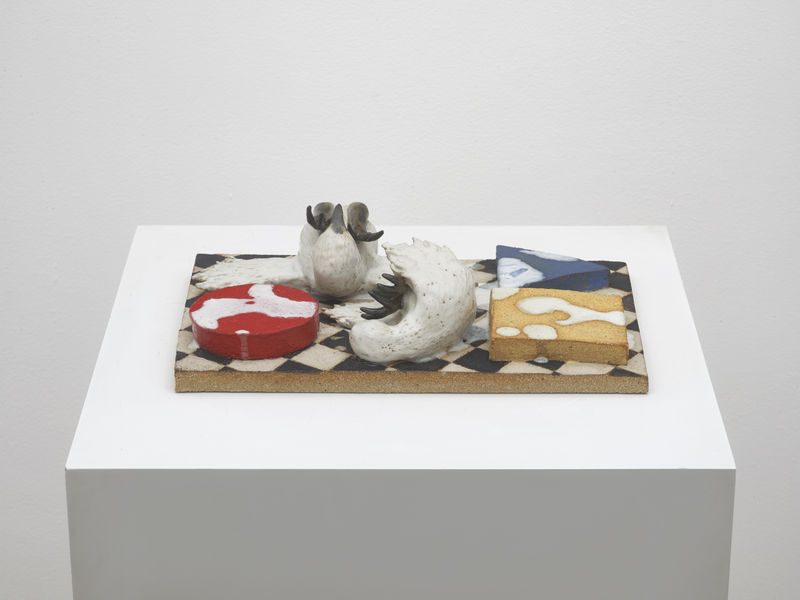
The square, triangle, and circle—famously painted by the Zen monk Sengai Gibon. These shapes are the universe itself, the transition from void to reality: the start of all things (the triangle), solidity or material existence (the square), and enlightenment or the infinite (the circle).
The star comes from Hildegard of Bingen. Hildegard was a 12th-century abbess and polymath. One of her books, Scivias, contains a vision called Extinct Stars: golden stars refuse God’s love and fall into the abyss. The stars become coal. This reminds me of the falling tears that become bullets in one of Porter’s collages.
The nest can be seen as a mandala and a portal. It is a nursery of course, promising new life, creation. Porter fills a nest with bullets and dangles a star over it, like a mobile over a child’s crib. The bullets and the star are opposing forces. Porter said, “A seagull made a nest on the roof of the abandoned car factory across from my studio. I watched it labour and then lay eggs and then all the chicks and then the parents fly away. The image has stuck in my head ever since.”
A bird falls out of its nest, out of the sky, like the stars. Has it fallen or been pushed? Porter says, “I have strong childhood memories of playing in the garden and finding little dead birds that had fallen out of their nests. Ironically, usually a sign of Spring.”
Arrows are portraits of possibility, red, yellow, green, orange. A painter combines colors and shapes, directing your eye. These arrows guide you to confusion, their bright colors emphatic, synthetic. They are a spectrum, from hot to cold, red, yellow, blue, and a statement of anguish, confusion, loss of direction, leading to nothingness. This spectrum can be found in other works, skyscapes, sunsets or sunrises, artificial. Primary colors are self-evident truths, the truth of the spectrum. The truth of transition, dawn or dusk.
The checkerboards and dice assert chance, which a roll of the dice will never abolish. Horizon and gameboard? The urge to risk everything? Alfred Hitchcock often set his characters on checkerboard floors. Porter’s are empty, like photos by the Surrealists, a record of imminence, a space in which something is going to happen.
The blackboards combine writing and artmaking in a direct way, but then something traumatic (childhood? loss?) obfuscates the message or delivers a message of impermanence. They are records of counting—to twenty-three—and marking the passage of time. Joseph Beuys used blackboards to assert a pedagogic social responsibility. For Porter they are the opposite, a withdrawal of communication, except to note the passage of time. Rich, what does twenty-three mean?
Our speculative bunny does not enjoy the energetic freedom of Barry Flanagan’s hares. Our bunny may be a Romantic poet, taking in the sublimity of a ruin--church, Stonehenge, sacred spaces--or a bewildered citizen watching his culture fall apart, as though he had been demoted to a universe that felt less real. Some of this work can be traced back to the isolation of the Covid years. Our bunny is an isolated actor who looks through the portal of Stonehenge at the sum total of human history, or into the empty darkness of a cardboard box with the watchful anxiety of a prey animal.
Porter offers us solitary doors, thresholds of all kinds, broken windows. What to do with the day and the wide blue sky? Mr. Bunny never doubts that a dark, busy, obscure world exists and that he is not in it, that he could not find his way to it even if he wanted to. The holes in ruins and empty boxes are put before us to consider entering or not. They offer experiences we have no access to, or liminal access of the beyond. Getting out of the window is achieved through some violence, breaking through, to an empty azure sky.
These images are actors that interpret spiritual states and systems. They are already on stages where spiritual dimensions and planes of existence collide. The paintings are already framed inside themselves, and the pedestals are already part of the sculptures, adding a kind of anguish or vertigo before the act of creation. They create meta-narratives open to interpretation, another kind of threshold. Porter is controlling a space that is also beyond control. Magic controls, chance does the opposite.
Porter’s primary shapes and symbols are emphatic as nursery rhymes. From a variety of traditions and from personal experience, they gather versions of emptiness and release, of commitment and confusion. They introduce badly needed randomness into our lives. Tension exists between opposing ideas, a longing for something that is beyond reach, a better world or perhaps a richer awareness hiding behind the emptiness.
Robert Glück
